Concentrations
For More Information, Contact:
Admissions Office
Admissions and Visitor Center
admissionsoffice@rmu.edu
800-762-0097 phone
412-397-5200 phone
412-397-2425 fax
Maria V. Kalevitch, Ph.D.
Dean, School of Engineering, Mathematics & Science
School of Engineering, Mathematics and Science
University Professor of Biology
Science
kalevitch@rmu.edu
412-397-4020 phone
412-397-2472 fax
John Jay 206
More Info
|
| Studies lead to the Bachelor of Arts (B.A.) in Environmental Science with available concentrations in pre-medicine and biology teacher certification.
What Is Environmental Science?
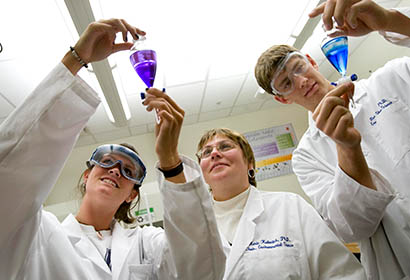
Environmental science is an applied science, incorporating knowledge from basic sciences such as chemistry, biology, geology, mathematics and physics, as
well as applied sciences such as agronomy, soil science, forestry and toxicology. Environmental scientists study some property of the environment or
apply scientific knowledge to an environmental issue or problem.
|
|
Environmental science degree programs provide a foundation in major science disciplines, but also develop an expertise in how the diverse areas of science can work
together to promote effective and beneficial uses of the planet's physical and biological resources while maintaining an ecological balance within and among the
biosphere, hydrosphere and lithosphere.
Unlike traditional science programs, environmental science degree programs include specialized courses that demonstrate how technology, business and management
practices can be applied to the aquatic, atmospheric and geologic systems of the planet for the betterment of mankind.
Program Overview
RMU's environmental science degree program uniquely trains environmental scientists for professional and technical positions in business, industry, government
and education by providing the analytical, technical and enterprise skills required of such positions.
The B.A. degree program is suited to students wishing to blend environmental science with other disciplines such as economics, political science, education or
computer science for careers in government, consulting or education.
The program requires significant coursework in biology, chemistry, earth sciences and physics, as well as a rigorous mathematics and applied statistics
component, and a comprehensive basic science exposure. Students receive hands-on experience through laboratory experiences, field trips and internships.
Capstone field methods courses require students to do field monitoring and analysis using the same state-of-the-art equipment found in industry.
Students benefit from the University's renowned Communication Skills Program. Because environmental science professionals are required to write reports and
present information in a variety of ways, such training provides RMU graduates with a competitive edge. In addition, business courses are incorporated into
the curriculum, giving graduates an enhanced ability to interact with non-science professionals in business, industry and government.
Pre-Medicine Concentration
The Pre-Medicine Concentration provides the intensive science background necessary for admission to medical, dental, veterinary or other professional health schools.
The curriculum lays the foundation for the understanding of basic life processes needed in the health professions. Students benefit from pre-medicine advising, MCAT
preparation seminars and the guidance of the University's pre-professional health committee.
Learn more.
Biology Teacher Certification Concentration
The Biology Teacher Certification Concentration prepares students to gain Pennsylvania certification as a secondary biology teacher, enabling them to
teach biological/life science, general science or environmental science courses in grades 7-12 and any science courses in grades 7-9. The curriculum includes
education courses and a student teaching component.
Curriculum Requirements
The B.A. in Environmental Science requires 123 credit hours. The curriculum has four components:
- Robert Morris University Core - 40 credits
These are the traditional liberal arts requirements of the University. Studies in humanities, communications skills, and social, behavioral, natural
and quantitative sciences are included.
- Science and Statistics - 23 credits
This component consists of a specified sequence of introductory physical and biological science courses to prepare students for more advanced course
work.
- Environmental Science - 23 credits
This component includes advanced course work and research in microbiology, ecology and environmental science.
- Other Requirements and Open Electives - 37 credits
This component permits students to select courses from other University offerings to personalize the program of study. A minimum of 24 credits must
be selected within one of the following academic schools: Business; Communications and Information Systems; Education; Engineering, Mathematics and Science;
or Nursing. Students also complete a senior thesis and/ or a practical internship experience as part of this component.
The B.A. in Environmental Science - Pre-Medicine Concentration requires 125 credit hours. The curriculum has four components:
- Robert Morris University Core - 41 credits
These are the traditional liberal arts requirements of the University. Studies in humanities, communications skills, and social, behavioral, natural
and quantitative sciences are included.
- Science and Statistics - 31 credits
This component consists of a specified sequence of introductory physical and biological science courses to prepare students for more advanced course
work.
- Environmental Science - 24 credits
This component includes advanced course work in microbiology, organic chemistry, ecology and environmental science.
- Pre-Medicine - 29 credits
This component includes courses in biology, genetics, neuroscience, organic chemistry, biochemistry and physics, as well as two MCAT preparation
seminars.
The B.A. in Environmental Science - Biology Teacher Certification Concentration requires 127 credit hours. The curriculum has three components:
- Robert Morris University Core - 39 credits
These are the traditional liberal arts requirements of the University. Studies in humanities, communications skills, and social, behavioral, natural
and quantitative sciences are included.
- Science - 58 credits
This component includes beginning and advanced course work in anatomy and physiology, biology, microbiology, genetics, chemistry, ecology,
geology, environmental science, meteorology, physics and statistics.
- Professional Education - 29 credits
This component provides the educational background necessary to gain certification to teach biology and general science at the secondary level
(grades 7-12).
Industry Demand
Large numbers of people are engaged in environmental careers in the United States. The federal government employs over 230,000 people in environmental and
conservation agencies. Nearly twice as many are employed at the state level. Primary and secondary schools are also significant employers; many states, including
Pennsylvania, require environmental science as part of the curricula. In the private sector, more than 113,000 organizations employ nearly 1.3 million people
engaging in activities ranging from analytical services to consulting and engineering to water treatment and waste management. Other employers include hospitals,
universities, law firms, insurance companies and banks.
The demand for environmental scientists in Western Pennsylvania is robust. Virtually every major environmental consulting and engineering organization
has a Pittsburgh area office. Both the Pennsylvania Department of Environmental Protection and Department of Conservation and Natural Resources have a significant
presence in the region. The Air and Waste Management Association, a 10,000-member professional organization, is headquartered in Pittsburgh. In addition, the
region boasts 50 state parks and recreation areas.
Career Options
A number of career paths are open to students who study environmental science. Bachelor-level positions in the government sector include naturalist, park
ranger, wildlife officer, game warden, and local, state or federal regulatory agent. Positions in the private sector include environmental laboratory and field
technician, ecologist, quality assurance professional, industrial hygienist, hazardous materials technician, environmental consultant, land use planner, soil
scientist and hydrologist. In the education sector, positions include teacher, researcher and environmental education specialist. Graduates may also pursue
graduate or professional studies in a variety of disciplines such as biology, chemistry, geology, meteorology, medicine and the health professions.
Bachelor-Level Hiring Organizations
Astorino Branch Environmental Inc.; Civil & Environmental Consultants Inc.; Conservation Consultants; Department of Agriculture; Energy & Environmental
Management Inc.; EnviroLink Network; PA Department of Conservation and Natural Resources; PA Department of Environmental Protection; PennDOT;
Pittsburgh Zoo & PPG Aquarium; Volz Environmental Services Inc.; Waste Management.
Salary Information
| 2006 national mean bachelor-level starting salaries by job function: |
| Agricultural/Natural Resources | $39,375 |
| Consulting | $42,333 |
| Environmental/Sanitation Engineering | $35,072 |
| Field Engineering | $58,625 |
| Research (Technical/Scientific) | $35,500 |
| Secondary Teaching | $31,259 |
|